
New York, March 2026 – Across luxury hospitality and commercial real estate, a quiet shift is underway. For decades, fresh-cut flowers and living greenery have been considered essential to creating a sense of refinement and natural beauty in interior spaces. Today, however, those same elements are increasingly viewed as operational liabilities—costly to maintain, inconsistent in appearance, and difficult to scale across large portfolios.
At the same time, artificial plants—once seen as a practical alternative—are falling out of favor in high-end environments, where authenticity, materiality, and environmental considerations play a growing role in design decisions.
Within this evolving landscape, preserved botanical design is emerging as a new category. Isabelle Back, founder and CEO of Nordblooms, is among the designers shaping this transition, positioning long-lasting natural installations not simply as decorative features, but as operational solutions embedded within the design strategy of luxury spaces.
“Fresh florals were never designed for the way modern hospitality operates,” Back explains. “They require constant monitoring, frequent replacement, and create a level of unpredictability that doesn’t align with how high-performing spaces need to function.”
In five-star hotel environments, where brand standards often require real flowers in guest rooms and public areas, these challenges become particularly visible. Leading five-star properties are now exploring in-room preserved florals to eliminate daily wilting checks across hundreds of guest rooms. Floral arrangements must be checked daily to ensure they remain visually consistent, while weekly replacement cycles introduce recurring costs, logistical coordination, and ongoing administrative burden. Variations in freshness can lead to inconsistencies across rooms, placing additional pressure on staff responsible for maintaining presentation standards.
Over time, these seemingly minor tasks accumulate into a significant operational load—one that extends beyond procurement costs to include staff time, management oversight, and the complexity of continuous ordering and invoicing cycles.
Back’s approach addresses these inefficiencies directly. Using real botanicals that have been preserved to maintain their appearance over extended periods, her installations eliminate the need for watering, sunlight, or routine replacement. The result is a system that maintains a consistent visual standard while removing the day-to-day demands traditionally associated with floral programs.
“Preserved design allows hotels to keep the experience of real flowers without the operational friction,” she says. “There’s no need to manage weekly deliveries, no last-minute replacements, and no variability from one day to the next.”
Industry estimates suggest that hotels implementing preserved botanical systems can reduce their annual fresh flower budgets by approximately 50 percent, while also freeing internal teams to focus on higher-value aspects of the guest experience. In large-scale environments, this shift can translate into measurable improvements in efficiency, consistency, and long-term cost planning.
The implications extend beyond individual properties. As hospitality groups and commercial operators scale across multiple locations, the ability to standardize design elements without increasing operational complexity has become increasingly important. Preserved botanical installations—ranging from in-room florals to large-scale trees, planters, and green walls—offer a level of flexibility that traditional greenery systems struggle to match.
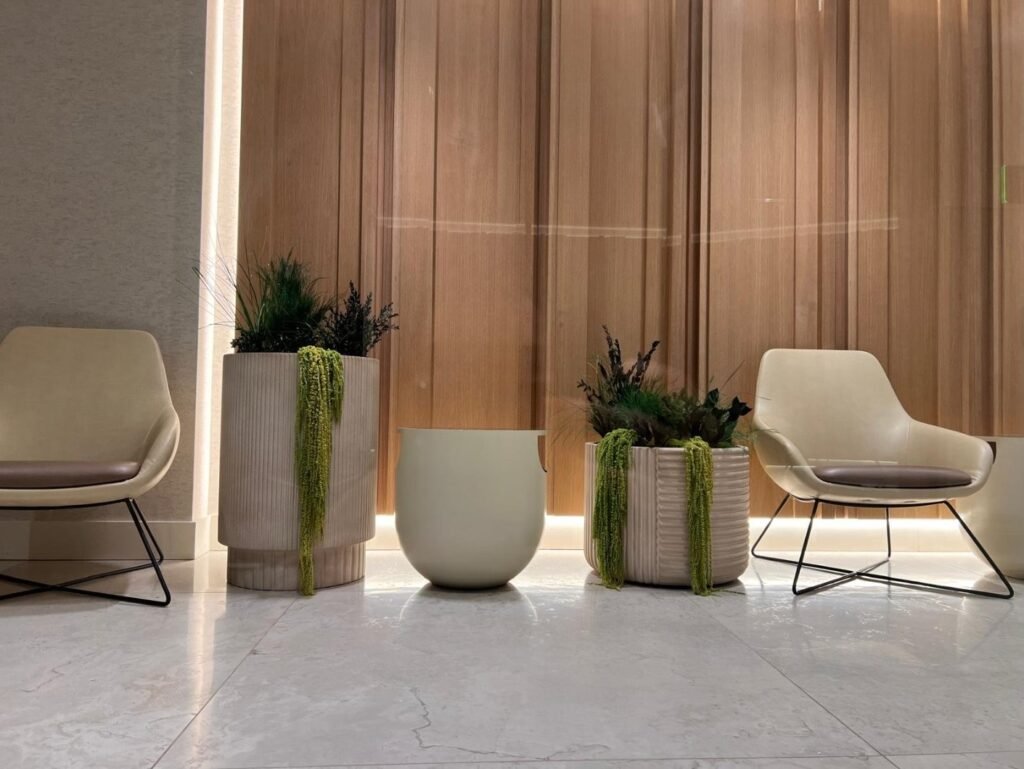
Unlike living plants, preserved elements can be placed in low-light or fully enclosed environments, expanding the possibilities for integrating natural materials throughout interior spaces. This versatility allows designers to create cohesive biophilic environments across lobbies, meeting rooms, corridors, and guest suites without being constrained by natural light conditions or maintenance requirements.
Back’s work also reflects a broader shift in how biophilic design is understood within the industry. While historically associated with aesthetics or sustainability, it is increasingly being evaluated through the lens of performance—how spaces function, how they are maintained, and how they support both operational teams and end users.
“Biophilic design is moving beyond visual impact,” Back notes. “It’s becoming part of how spaces are engineered to perform—operationally, commercially, and experientially.”
This evolution is influencing how architects, designers, and operators approach interior planning. Rather than treating greenery as an isolated feature, there is growing emphasis on integrated systems that work holistically across a space. Trees, planters, walls, and florals are being considered as part of a unified design language—one that supports both the visual identity of a brand and the practical realities of maintaining it.
Back’s IFDA membership positions her at the center of these industry conversations shaping the future of commercial interiors.
As expectations for luxury environments continue to evolve, the role of design is expanding beyond aesthetics alone. In an industry where consistency, scalability, and operational clarity are increasingly critical, preserved botanical systems represent a new approach—one that aligns natural beauty with the demands of modern space management.
For Back, this signals a longer-term transformation. “The future of interiors isn’t about choosing between beauty and practicality,” she says. “It’s about designing systems that deliver both, seamlessly.”